
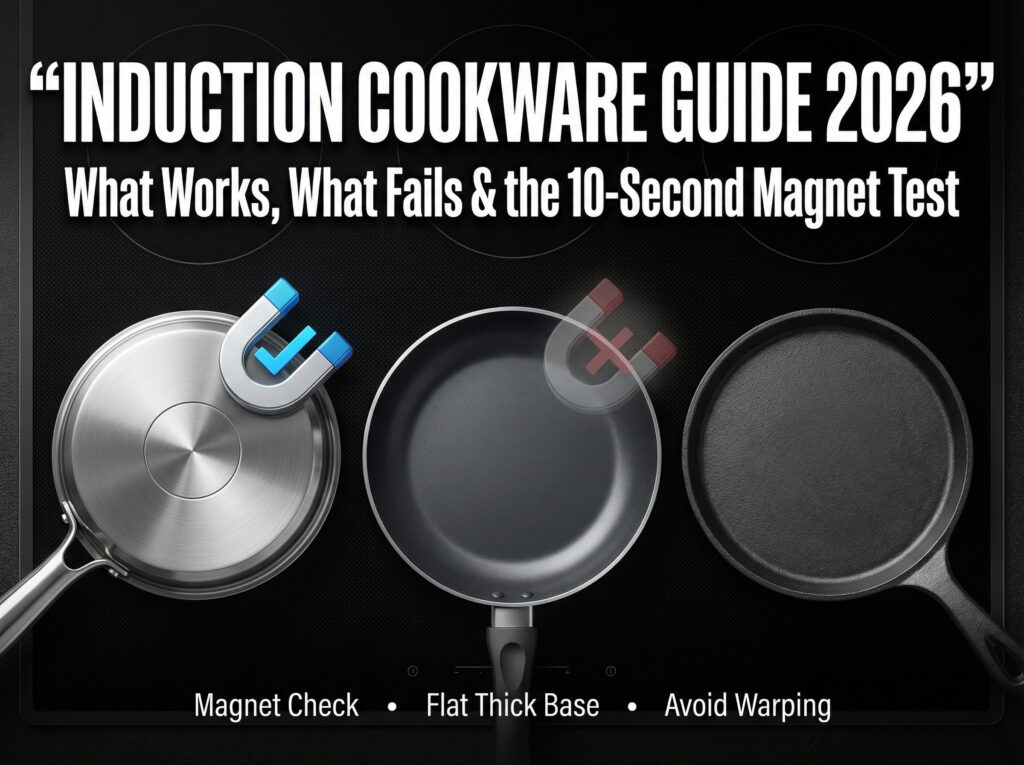
In 2026, many people buy an induction stove and then waste money on the wrong cookware. The pan looks perfect, but it heats slowly or doesn’t work at all. This happens because induction needs one specific thing: a magnetic base.
This guide helps you choose induction cookware that actually performs well, lasts longer, and cooks evenly.
1) What makes cookware “induction compatible” (simple)
Induction doesn’t heat the pan using flame. It uses a magnetic field to heat the base.
So the cookware must have a ferromagnetic (magnet-attracting) base.
If the base isn’t magnetic, it won’t work properly — or won’t work at all.
2) The 10-second test before buying
Do this simple test:
- Take a magnet (even a fridge magnet)
- Touch it to the bottom of the pan
✅ If the magnet sticks strongly → induction compatible
❌ If it doesn’t stick (or sticks very weakly) → don’t buy for induction
This is the quickest way to avoid wrong purchases.
3) Best materials for induction cooking (what to choose)
Stainless steel (good quality)
- Durable
- Hygienic
- Works great if the base is induction-grade
- Some models heat slower unless base is thick
Cast iron
- Excellent heat retention
- Great for dosa/roti-style cooking
- Very durable
- Heavy and needs proper care (avoid rust)
Tri-ply / multi-layer steel (premium but worth it)
- Even heating
- Better cooking control
- Usually long-lasting
These are usually the safest choices for induction.
4) Materials people often buy by mistake
Aluminium (most types)
- Usually NOT induction compatible unless it has a special induction base layer
Glass/ceramic cookware
- Generally not compatible unless designed for induction (rare)
Non-stick pans (cheap ones)
- Many cheap non-stick pans warp fast and lose contact with induction surface
- Even if induction compatible, performance can be disappointing if base is thin
5) Base thickness matters more than people think
In induction cookware, the base quality decides:
- heating speed
- even cooking
- durability (warping)
Thin base = hot spots + warping + uneven cooking.
A thicker, solid base gives better results and lasts longer.
6) Flat base is mandatory
Induction works best when the pan sits flat on the surface.
Avoid cookware that:
- wobbles
- has a curved base
- bends easily
Even slight warping reduces heating efficiency.
7) What size cookware works best on induction?
If the pan base is too small for the induction zone, it heats poorly.
Quick buying checklist (save this)
- Magnet sticks strongly to the base
- Base is flat and thick
- Doesn’t wobble
- Material: stainless steel / cast iron / tri-ply preferred
- Avoid super-cheap thin non-stick for long-term use
Final takeaway
In 2026, the best induction cookware is the one with a strong magnetic base, flat thick bottom, and material that heats evenly. Don’t buy based on looks. Do the magnet test and check the base quality — it saves money and frustration.
Written by: Wayanad Metals Team
We help customers choose practical kitchen and home products based on usage and long-term value. If you want quick guidance, message us on WhatsApp.